Friday, December 31, 2010
Kohler: Das Tierleben im Sprichwort der Griechen und Römer
Das Tierleben im Sprichwort der Griechen und Römer, by Carl Sylvio Köhler (1881).
This is a delightful collection of Latin and Greek animal proverbs, arranged by animal. The commentary is in German, but even if you just read Latin and/or Greek, the book is a lot of fun. It's very similar to the book that I hope to do this summer, although I will be focusing on Latin proverbs, and looking at Latin proverbs over the millennia, not just in ancient Rome. If you are interested in specifically Roman proverbs about the animals, this is a great book to explore!
.


Wednesday, December 29, 2010
Schottus: Adagia, sive Proverbia Graecorum
Paroimiai Hellenikai: Adagia, sive Proverbia Graecorum, ed. Andreas Schottus (1612)
This is a fantastically useful book, containing the Greek proverb collections of Zenobius and Diogenianus, as well as over 1000 proverbs harvested from the Suda, with Latin translations and commentary by Andreas Schottus. Very readable, and in many ways more useful than Erasmus's Adagia, which often draw on these same Greek sources. I've found lots of great proverbs and Latin commentary here to use in my animal proverbs book next summer!

.
Monday, December 27, 2010
Polydore: Adagia
Adagiorum opus, by Polydorus Vergilius (1532)
You can read about Polydore Vergil in this Wikipedia article; his Adagia are very helpfully divided into the "Profane" and the "Sacred." In addition to the GoogleBooks edition which you can download to your computer, be sure to check out the EXCELLENT edition that Dana Sutton has provided online, which includes an English translation plus notes: Polydore Vergil, Adagiorum Liber (1521 version).

.
Saturday, December 25, 2010
Freytag: Arabum Proverbia
Arabum proverbia, by Georg Wilhelm Freytag (1838-1839)
- GoogleBooks - Vol. 1 - Vol. 2 - Vol. 3/1 - Vol. 3/2
- GoogleBookstore - Vol. 1 - Vol. 2 - Vol. 3/1 - Vol. 3/2
This monumental THREE-volume edition provides the voweled Arabic text along with a Latin translation and commentary on each of the proverbs in Latin, organized alphabetically in Arabic. It's an amazing adventure in the world of proverbs. Here's a snapshot:

.
Thursday, December 23, 2010
Glandorpius: Latihnsche Disticha
Ioannes Glandorpius. Latihnsche Disticha. ed. W.H.D. Suringar. 1874.
This is a collection of Latin proverbs in the form of two-line poems (distichs). This old tradition of two-line proverbs goes back to the famous Distichs of Cato (or pseudo-Cato, that is). Thanks to Suringar's masterful edition of Bebelius, I have been finding more modern collections of distichs like this one by Glandorpius, a German Renaissance scholar and humanist who died in 1564. What a delight!
.
Sunday, December 19, 2010
Bovillus: Proverbia Vulgares
Proverbia Vulgares: libri tres, by Charles de Bovelles (Carolus Bovillus). 1531.
This is an astounding book of popular proverbs in French and Latin, with accompanying commentary in Latin by the great French Renaissanc scholar, Charles Bovelles. You can read an article about Bouelles' extraordinary intellectual output in this Wikipedia article.

.
Saturday, December 11, 2010
Whitney: Choice of Emblemes
Whitney's "Choice of Emblemes" - a facsimile reprint. 1866.
Whitney's book is a wonderful way to become acquainted with the family of emblem literature going back to Alciato's emblems. Here's an example, the emblem for the story of the donkey carrying the icon!

.
Faernus: Fabulae Centum cum Imaginibus
Fabulae Centum, cum Imaginibus in aes incisis, notisque illustrata, Studio Othonis Vaeni by Gabrielis Faernus. 1743.
What a treat! Here are the fables of Faernus, with emblematic illustrations from the studio of Vaenius! A sample, from the fable of the raging lion:

.
Offelen: Symbola et Emblemata
Symbola et Emblemata by Heinrich Offelen. 1705.
Here is an example of some of the emblem images in the book, each of which is accompanied by text, too:

.
Vaenius: Quinti Horatii Flacci Emblemata
Quinti Horatii Flacci Emblemata: Imaginibus in aes incisis, notisque illustrata by Quintus Horatius Flaccus, Otto van Veen (Octavius Vaenius). 1612.
You can read about Octavius Vaenius in this Wikipedia article. Here is one of the engravings from the book:

.
Cornhertius: Emblemata Moralia et OEconomica
Emblemata Moralia et OEconomica, de rerum usu et abusu by Dirck Volckertszoon Coornhert (Cornhertius). 1609.
I found this portrait of the author, Cornhertius, online, and you can read more about in this Wikipedia article:

.
Sambucus: Emblemata
Emblemata, cum aliquot nummis antiqui operis by Johannes Sambucus. 1564.
Here's an example of a Hercules emblem from the book!

.
de la Faye: Emblemata et Epigrammata
Emblemata et Epigrammata Miscellanea selecta ex stromatis peripateticis by Antonius Fayus (Antoine de La Faye). 1610.
Antoine de la Faye (1540-1615 ) was the successor to Theodore Beza in his theology post at Geneva.
.
GoogleBooks PDF and GoodReader
I thought I would post some notes here about how I use the books at GoogleBooks - my approach is to download them as PDF files to my computer and/or to my iPad and then annotate the PDFs as I read them. It works out great for me, and it is all free - except for the 99 cents I spent on the GoodReader app for my iPad. I love working with the books this way - here's a step by step of just how I do that on the iPad. I need to be online to do the downloading, but then I can read the books offline, no need for any kind of Internet connection.
Download PDFs using GoodReader. GoodReader is the app I use the most on my iPad. There are lots of ways to get PDFs onto the iPad, but the way I usually do that is by downloading PDF files directly from the GoogleBooks website. So, to add books to my iPad library, I open the GoodReader app and then go to the Web Downloads panel. I choose Browse Web, and I browse until I get to the book view page at Google Books, where there is a PDF link - when I reach this link, I don't follow the link - I download the file! I also have PDF links here in the posts at this blog to make it easy to find and download the actual GoogleBook to my iPad.
After the PDF file downloads to GoodReader, I usually rename the file and put it in one of the folders I've created at GoodReader to save my hundreds of PDFs. The file management options in GoodReader are really excellent. I am able to keep hundreds of PDFs nicely organized there.
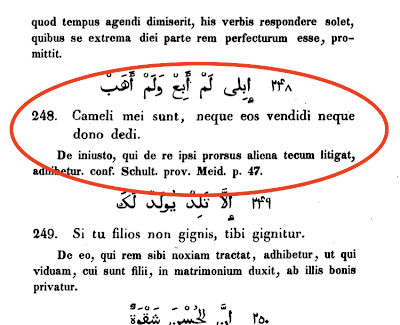
Read and annotate the PDF. It is such a pleasure to read these books on the iPad (here's a tip: make sure you enable to page cache setting in GoodReader, so that you will not have to wait in-between pages as you page through a super-gigantic PDF file). Whenever I want to annotate something, I can leave a bookmark, or circle it with a big red circle, or leave a note. It's so easy - I just touch the screen and choose what kind of annotation I want to make! Here are two screenshots that show how it looks. The red circle is perfect for marking proverbs I want to grab and put into my database:
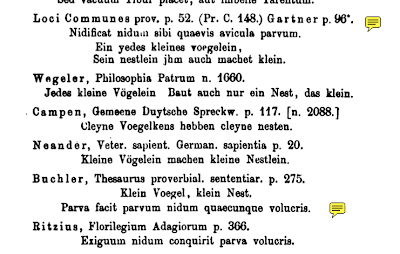
Here are the little yellow "stickies" that get left behind where I leave a note to myself (I click on the stickies to read the note, but often I leave just a blank note since the little stickies themselves are a nice kind of marker to leave behind):
 After I've finished reading a book, then I prop the iPad on my study desk and start transcribing the proverbs and fables that I've found into the database on my desktop computer. What a great way to work!


If you have any tips on reading and using GoogleBooks, feel free to leave a comment at this blog post!
.
Download PDFs using GoodReader. GoodReader is the app I use the most on my iPad. There are lots of ways to get PDFs onto the iPad, but the way I usually do that is by downloading PDF files directly from the GoogleBooks website. So, to add books to my iPad library, I open the GoodReader app and then go to the Web Downloads panel. I choose Browse Web, and I browse until I get to the book view page at Google Books, where there is a PDF link - when I reach this link, I don't follow the link - I download the file! I also have PDF links here in the posts at this blog to make it easy to find and download the actual GoogleBook to my iPad.

After the PDF file downloads to GoodReader, I usually rename the file and put it in one of the folders I've created at GoodReader to save my hundreds of PDFs. The file management options in GoodReader are really excellent. I am able to keep hundreds of PDFs nicely organized there.
Read and annotate the PDF. It is such a pleasure to read these books on the iPad (here's a tip: make sure you enable to page cache setting in GoodReader, so that you will not have to wait in-between pages as you page through a super-gigantic PDF file). Whenever I want to annotate something, I can leave a bookmark, or circle it with a big red circle, or leave a note. It's so easy - I just touch the screen and choose what kind of annotation I want to make! Here are two screenshots that show how it looks. The red circle is perfect for marking proverbs I want to grab and put into my database:

Here are the little yellow "stickies" that get left behind where I leave a note to myself (I click on the stickies to read the note, but often I leave just a blank note since the little stickies themselves are a nice kind of marker to leave behind):
 After I've finished reading a book, then I prop the iPad on my study desk and start transcribing the proverbs and fables that I've found into the database on my desktop computer. What a great way to work!


If you have any tips on reading and using GoogleBooks, feel free to leave a comment at this blog post!
.
Friday, December 10, 2010
Riley: Dictionary of Latin Quotations
Dictionary of Latin Quotations, Proverbs, Maxims, and Mottos, Classical and Medieval, by Henry Thomas Riley. 1866.
If you are looking for a big book of Latin proverbs and quotations accompanied by ENGLISH TRANSLATIONS, then Riley's book is one that I would highly recommend! It also contains around 500 Greek quotations in an appendix at the end of the book. The Latin is marked with a number of short marks and long marks over any potentially ambiguous vowels (vowels not already long by position in words of three syllables or more) to aid in pronunciation. Riley's book is over 500 pages long, and a fun read from start to finish, all the way from A bove maiori discit arare minor to Zonam perdidit.
For more Latin Proverb books, see this Latin Proverb Bibliography post.
.
Thursday, December 9, 2010
Bibliography: Latin Proverbs
Here are the books with Latin Proverbs that I have found at GoogleBooks, listed here by title; I'll be expanding on these items with real bibliographical entries as I work through the books.
GoogleBooks: Adagia: i. e. : Proverbiorum, paroemiarum et parabolarum omnium by (many authors). 1629.
GoogleBooks: Adagia ex celeberrimis scriptoribus tam latinis, quàm polonicis by Arnold Kazimierz Zeglicki. 1751.
GoogleBooks: Adagia quaedam ac carmina magis obvia et ex optimis quibusdam auctoribus collecta. Anonymous? 1727.
GoogleBooks: Adagiorum centuriae VIII. cum dimidia by Hadrianus Junis. 1558.
GoogleBooks: Adagiorum, chiliades tres by Joannes Sartorius, ed. by Cornelis Schrevel. 1670.
GoogleBooks: Adagiorum maxime vulgarium thesaurus by Sint-Adriaanscollege Geraardsbergen. 1730
GoogleBooks: Adagiorum medicinalium centuria by Johann J. Baier. 1718.
GoogleBooks: Adagiorum Seu Proverbialium Versuum Ex Aeneide, Georgicis Et Bucolicis P. Vergilii Maronis by Valentin Rotmar. 1577.
GoogleBooks: Alphabetum morale politicum selectis. Sententiarum by Vitus Faber. 1679.
GoogleBooks: Altspanische sprichwörter und sprichwörthliche redensarten . 1883.
GoogleBooks: Analogous proverbs in ten languages, by Mrs. E. B. Mawr. 1885.
GoogleBooks: Ancient and modern familiar quotations from the Greek, Latin, and modern languages. (Lippincott Publishers) 1875.
GoogleBooks: Anthologia sententiarum arabicarum by Henrik Albert Schultens. 1772.
GoogleBooks: Anthologia sive florilegium rerum et materiarum selectarum by Joseph Lang. 1674.
Googlebooks: Apophthegmata Graecolatina by Johann Possel. 1595.
GoogleBooks: Arabum proverbia by Georg Wilhelm Freytag, vol. 1 - GoogleBooks: vol. 2. 1838.
GoogleBooks: A book of quotations, proverbs and household words by Sir William Gurney Benham. 1907
GoogleBooks: The book of sun-dials by Mrs. Alfred Gatty. 1900.
GoogleBooks: Centum Adagia Malabarica. 1791.
GoogleBooks: Classical and foreign quotations: a polyglot manual by William Francis Henry King. 1904.
GoogleBooks: Clavis Homerica - Michaelis Apostolii Proverbai Graeco-Latina. 1831.
GoogleBooks: De comparationibus Plautinis et Terentianis ad animalia spectantibus by Ernst Franz Wortmann. 1883.
GoogleBooks: The cyclopedia of practical quotations, English and Latin. J.K. Hoyt and A.L. Ward, 1886.
GoogleBooks: Delectus sententiarum et historiarum ad usum tironum accommodatus by Richard Valpy. 1813.
GoogleBooks: Denkmäler deutscher Poesie und Prosa aus dem VIII. - XII. Jahrhundert by Karl Müllenhoff. 1864.
GoogleBooks: Deutsches Sprichwörter-Lexikon by Karl Friedrich Wilhelm Wander. 1873.
GoogleBooks: Devises: cris de guerre, légendes, dictons by Joseph de Champeaux. 1890.
GoogleBooks: Dictionarium paroemiarum by Franz Joseph Hartleben. 1818.
GoogleBooks: Dictionary of foreign phrases and classical quotations by Hugh Percy Jones. 1908.
GoogleBooks: A dictionary of Latin phrases by William Robertson. 1824.
BLOG POST: Dictionary of Latin quotations, proverbs, maxims, and mottos by Henry Thomas Riley. 1866.
GoogleBooks: Dictionary of quotations (Classical) by Thomas Harbottle. 1906.
GoogleBooks: Dictionary of quotations from ancient and modern, English and foreign sources by Rev. James Wood. 1893.
GoogleBooks: Dictionary of quotations, from the Latin, French, Greek, Spanish, and Italian languages by D E. Macdonnel. 1858.
GoogleBooks: A dictionary of quotations from various authors in ancient and modern languages by Hugh Moore. 1831.
GoogleBooks: A Dictionary of Select and Popular Quotations. 1873.
GoogleBooks: Dictionnaire des devises historiques et héraldiques. 1878.
GoogleBooks: Famous sayings and their authors by Edward Latham. 1906.
GoogleBooks: Flores et Sententiae. 1713.
GoogleBooks: Florilegium ethico-politicum by Janus Gruterus. 1611.
GoogleBooks: Florilegium Latinum by F. Frommelt. 1868.
GoogleBooks: Florilegium latinum by Juan de Lama. 1793.
BLOG POST: Florilegium proverbiorum universae latinitatis by Eduardus Margalitis.
GoogleBooks: Florilegium sententiarum by 1695.
GoogleBooks: Foreign phrases in daily use. (Funk and Wagnalls) 1906
GoogleBooks: A General and heraldic dictionary of the peerage and baronetage of the British Empire by John Burke, vol. 1 - GoogleBooks: vol. 2. 1832.
GoogleBooks: Glossarium van de oud-Hollandsche en midden-eeuwsch Latijnsche woorden by Willem Hendrik Dominicus Suringar. 1865.
GoogleBooks: Gnomologia by Thomas Fuller. 1732.
GoogleBooks: Gnomologia by Karl Ernst Georges. 1863.
GoogleBooks: Gnomologia seu Repertorium Sententiarum by F. Le Tort. 1581.
GoogleBooks: Gnomologia: seu, sententiarum, memorabilium descriptio by Johann Buchler. 1602.
GoogleBooks: Great thoughts from Latin authors by Craufurd Tait Ramage. 1884.
GoogleBooks: Horae belgicae by August Heinrich Hoffmann von Fallersleben. 1838.
GoogleBooks: Illustrium poetarum flores by Octavianus Mirandula. 1629.
GoogleBooks: Latin maxims and phrases by John Trayner. 1894.
GoogleBooks: Latin proverbs and quotations, by Alfred Henderson. 1869.
GoogleBooks: Lexikon lateinischer citate by W. Kayser. 1899.
GoogleBooks: Liber proverbiorum Salomonis, carmine elegiaco redditus by Joachim Tydichius, Boceldus Sasbotus Vander Burch. 1573.
GoogleBooks: Medulla proverbiorum Latinorum by Wilhelm Christian Binder. 1856.
GoogleBooks: Morales sententiae aureae by Antonio Gaza. 1641.
GoogleBooks: A new dictionary of quotations from the Greek, Latin, and modern languages (Lippincott). 1869.
GoogleBooks: Nova proverbiorum farrago by Jan Fongers. 1585.
GoogleBooks: Novus thesaurus adagiorum latinorum: Lateinischer sprichwörterschatz by Wilhelm Binder. 1861. (GoogleBooks: Recensie by Willem Hendrik Dominicus Suringar)
GoogleBooks: Östnordiska och latinska medeltidsordspråk by Peder Låle. 1894.
GoogleBooks: Paroimiai Ellenikai: Adagia sive Proverbia graecorum. Andreas Schottus. 1612.
GoogleBooks: Philosophia patrum versibus praesertim leoninis by Julius Wegeler. 1869.
GoogleBooks: Phraseologia Anglo-Latina and Parœmiologia Anglo-Latina, by T. Willis and W. Walker. 1672.
GoogleBooks: Polyanthea by Domenico Nani Mirabelli, Bartholomaeus Amantius. 1574.
GoogleBooks: Polyanthea nova by Joseph Lange. 1607.
GoogleBooks: Polydori Vergilii Urbi Adagiorum opus by Polydorus Vergilius. 1525.
GoogleBooks: Principia legis et æquitatis by Thomas Branch. 1824.
GoogleBooks: Promptuarium sententiarum ex veterum scriptorum romanorum libris by Moritz Ludwig Seyffert. 1864.
GoogleBooks: The promus of formularies and elegancies by Francis Bacon, ec. Mrs. Henry Pott. 1883.
GoogleBooks: Proverbia Germanica, Henricus Bebelius, ed. W. H. D. Suringar. 1879.
GoogleBooks: Proverbia vulgares: libri tres by Charles de Bouelles. 1531.
GoogleBooks: Proverbiorum Arabicorum centuriae duae by Joseph Juste Scaliger, Thomas Erpenius. 1623.
GoogleBooks: Proverbiorum Classes Duae by Johannes Drusius. 1590.
GoogleBooks: Proverbs and their lessons by Richard Chenevix Trench. 1857.
GoogleBooks: Refranes, y modos de hablar castellanos by Jerónimo Martín Caro y Cejudo. 1792.
GoogleBooks: La sapienza del mondo, vol. 1 - GoogleBooks: La sapienza del mondo, vol. 2 - GoogleBooks: La sapienza del mondo, vol. 3 by G. Strafforello. 1883.
GoogleBooks: Selectiora adagia Latino-Germanica by Johann Georg Seybold. 1683.
GoogleBooks: Sententiae cum F.I. Desbillonii emendationibus by Publilius (Syrus). 1829.
GoogleBooks: Sententiae et proverbia ex Plauto, Terentio, Virgilio. 1548.
GoogleBooks: Sententiae veterum poetarum by Georg Maior. 1574.
GoogleBooks: Sprichwörter der germanishcen und romanischen Sprachen Vergleichend by Ida von Düringsfeld and Otto Reinsberg-Düringsfeld, Vol. 1 - GoogleBooks: Vol. 2. 1872
GoogleBooks: Die Sprichwörter und Sinnreden des deutschen Volkes in alter und neuer Zeit by Joseph Eiselein. 1840.
GoogleBooks: Die Sprichwörter und sprichwörtlichen Redensarten der Römer by A. Otto. 1890 + GoogleBooks: A collection of Latin proverbs supplementing Otto's Sprichwörter by Morris Crater Sutphen. 1902.
GoogleBooks: Sprichwörterbuch in sechs sprachen by Georg von Gaal. 1830.
GoogleBooks: Sylvula sententiarum by Christian Gerber. 1700.
GoogleBooks: A synopsis of 'our favourite old sayings', in English and Latin by Cantab. 1872.
GoogleBooks: Thesaurus documentorum moralium. H. Schriftuer and HH. Vaders. 1755.
GoogleBooks: Das Tierleben im Sprichwort der Griechen und Römer by Carl Sylvio Köhler. 1881.
GoogleBooks: 3500 ex libris italiani by Jacopo Gelli. 1908.
.
GoogleBooks: Adagia: i. e. : Proverbiorum, paroemiarum et parabolarum omnium by (many authors). 1629.
GoogleBooks: Adagia ex celeberrimis scriptoribus tam latinis, quàm polonicis by Arnold Kazimierz Zeglicki. 1751.
GoogleBooks: Adagia quaedam ac carmina magis obvia et ex optimis quibusdam auctoribus collecta. Anonymous? 1727.
GoogleBooks: Adagiorum centuriae VIII. cum dimidia by Hadrianus Junis. 1558.
GoogleBooks: Adagiorum, chiliades tres by Joannes Sartorius, ed. by Cornelis Schrevel. 1670.
GoogleBooks: Adagiorum maxime vulgarium thesaurus by Sint-Adriaanscollege Geraardsbergen. 1730
GoogleBooks: Adagiorum medicinalium centuria by Johann J. Baier. 1718.
GoogleBooks: Adagiorum Seu Proverbialium Versuum Ex Aeneide, Georgicis Et Bucolicis P. Vergilii Maronis by Valentin Rotmar. 1577.
GoogleBooks: Alphabetum morale politicum selectis. Sententiarum by Vitus Faber. 1679.
GoogleBooks: Altspanische sprichwörter und sprichwörthliche redensarten . 1883.
GoogleBooks: Analogous proverbs in ten languages, by Mrs. E. B. Mawr. 1885.
GoogleBooks: Ancient and modern familiar quotations from the Greek, Latin, and modern languages. (Lippincott Publishers) 1875.
GoogleBooks: Anthologia sententiarum arabicarum by Henrik Albert Schultens. 1772.
GoogleBooks: Anthologia sive florilegium rerum et materiarum selectarum by Joseph Lang. 1674.
Googlebooks: Apophthegmata Graecolatina by Johann Possel. 1595.
GoogleBooks: Arabum proverbia by Georg Wilhelm Freytag, vol. 1 - GoogleBooks: vol. 2. 1838.
GoogleBooks: A book of quotations, proverbs and household words by Sir William Gurney Benham. 1907
GoogleBooks: The book of sun-dials by Mrs. Alfred Gatty. 1900.
GoogleBooks: Centum Adagia Malabarica. 1791.
GoogleBooks: Classical and foreign quotations: a polyglot manual by William Francis Henry King. 1904.
GoogleBooks: Clavis Homerica - Michaelis Apostolii Proverbai Graeco-Latina. 1831.
GoogleBooks: De comparationibus Plautinis et Terentianis ad animalia spectantibus by Ernst Franz Wortmann. 1883.
GoogleBooks: The cyclopedia of practical quotations, English and Latin. J.K. Hoyt and A.L. Ward, 1886.
GoogleBooks: Delectus sententiarum et historiarum ad usum tironum accommodatus by Richard Valpy. 1813.
GoogleBooks: Denkmäler deutscher Poesie und Prosa aus dem VIII. - XII. Jahrhundert by Karl Müllenhoff. 1864.
GoogleBooks: Deutsches Sprichwörter-Lexikon by Karl Friedrich Wilhelm Wander. 1873.
GoogleBooks: Devises: cris de guerre, légendes, dictons by Joseph de Champeaux. 1890.
GoogleBooks: Dictionarium paroemiarum by Franz Joseph Hartleben. 1818.
GoogleBooks: Dictionary of foreign phrases and classical quotations by Hugh Percy Jones. 1908.
GoogleBooks: A dictionary of Latin phrases by William Robertson. 1824.
BLOG POST: Dictionary of Latin quotations, proverbs, maxims, and mottos by Henry Thomas Riley. 1866.
GoogleBooks: Dictionary of quotations (Classical) by Thomas Harbottle. 1906.
GoogleBooks: Dictionary of quotations from ancient and modern, English and foreign sources by Rev. James Wood. 1893.
GoogleBooks: Dictionary of quotations, from the Latin, French, Greek, Spanish, and Italian languages by D E. Macdonnel. 1858.
GoogleBooks: A dictionary of quotations from various authors in ancient and modern languages by Hugh Moore. 1831.
GoogleBooks: A Dictionary of Select and Popular Quotations. 1873.
GoogleBooks: Dictionnaire des devises historiques et héraldiques. 1878.
GoogleBooks: Famous sayings and their authors by Edward Latham. 1906.
GoogleBooks: Flores et Sententiae. 1713.
GoogleBooks: Florilegium ethico-politicum by Janus Gruterus. 1611.
GoogleBooks: Florilegium Latinum by F. Frommelt. 1868.
GoogleBooks: Florilegium latinum by Juan de Lama. 1793.
BLOG POST: Florilegium proverbiorum universae latinitatis by Eduardus Margalitis.
GoogleBooks: Florilegium sententiarum by 1695.
GoogleBooks: Foreign phrases in daily use. (Funk and Wagnalls) 1906
GoogleBooks: A General and heraldic dictionary of the peerage and baronetage of the British Empire by John Burke, vol. 1 - GoogleBooks: vol. 2. 1832.
GoogleBooks: Glossarium van de oud-Hollandsche en midden-eeuwsch Latijnsche woorden by Willem Hendrik Dominicus Suringar. 1865.
GoogleBooks: Gnomologia by Thomas Fuller. 1732.
GoogleBooks: Gnomologia by Karl Ernst Georges. 1863.
GoogleBooks: Gnomologia seu Repertorium Sententiarum by F. Le Tort. 1581.
GoogleBooks: Gnomologia: seu, sententiarum, memorabilium descriptio by Johann Buchler. 1602.
GoogleBooks: Great thoughts from Latin authors by Craufurd Tait Ramage. 1884.
GoogleBooks: Horae belgicae by August Heinrich Hoffmann von Fallersleben. 1838.
GoogleBooks: Illustrium poetarum flores by Octavianus Mirandula. 1629.
GoogleBooks: Latin maxims and phrases by John Trayner. 1894.
GoogleBooks: Latin proverbs and quotations, by Alfred Henderson. 1869.
GoogleBooks: Lexikon lateinischer citate by W. Kayser. 1899.
GoogleBooks: Liber proverbiorum Salomonis, carmine elegiaco redditus by Joachim Tydichius, Boceldus Sasbotus Vander Burch. 1573.
GoogleBooks: Medulla proverbiorum Latinorum by Wilhelm Christian Binder. 1856.
GoogleBooks: Morales sententiae aureae by Antonio Gaza. 1641.
GoogleBooks: A new dictionary of quotations from the Greek, Latin, and modern languages (Lippincott). 1869.
GoogleBooks: Nova proverbiorum farrago by Jan Fongers. 1585.
GoogleBooks: Novus thesaurus adagiorum latinorum: Lateinischer sprichwörterschatz by Wilhelm Binder. 1861. (GoogleBooks: Recensie by Willem Hendrik Dominicus Suringar)
GoogleBooks: Östnordiska och latinska medeltidsordspråk by Peder Låle. 1894.
GoogleBooks: Paroimiai Ellenikai: Adagia sive Proverbia graecorum. Andreas Schottus. 1612.
GoogleBooks: Philosophia patrum versibus praesertim leoninis by Julius Wegeler. 1869.
GoogleBooks: Phraseologia Anglo-Latina and Parœmiologia Anglo-Latina, by T. Willis and W. Walker. 1672.
GoogleBooks: Polyanthea by Domenico Nani Mirabelli, Bartholomaeus Amantius. 1574.
GoogleBooks: Polyanthea nova by Joseph Lange. 1607.
GoogleBooks: Polydori Vergilii Urbi Adagiorum opus by Polydorus Vergilius. 1525.
GoogleBooks: Principia legis et æquitatis by Thomas Branch. 1824.
GoogleBooks: Promptuarium sententiarum ex veterum scriptorum romanorum libris by Moritz Ludwig Seyffert. 1864.
GoogleBooks: The promus of formularies and elegancies by Francis Bacon, ec. Mrs. Henry Pott. 1883.
GoogleBooks: Proverbia Germanica, Henricus Bebelius, ed. W. H. D. Suringar. 1879.
GoogleBooks: Proverbia vulgares: libri tres by Charles de Bouelles. 1531.
GoogleBooks: Proverbiorum Arabicorum centuriae duae by Joseph Juste Scaliger, Thomas Erpenius. 1623.
GoogleBooks: Proverbiorum Classes Duae by Johannes Drusius. 1590.
GoogleBooks: Proverbs and their lessons by Richard Chenevix Trench. 1857.
GoogleBooks: Refranes, y modos de hablar castellanos by Jerónimo Martín Caro y Cejudo. 1792.
GoogleBooks: La sapienza del mondo, vol. 1 - GoogleBooks: La sapienza del mondo, vol. 2 - GoogleBooks: La sapienza del mondo, vol. 3 by G. Strafforello. 1883.
GoogleBooks: Selectiora adagia Latino-Germanica by Johann Georg Seybold. 1683.
GoogleBooks: Sententiae cum F.I. Desbillonii emendationibus by Publilius (Syrus). 1829.
GoogleBooks: Sententiae et proverbia ex Plauto, Terentio, Virgilio. 1548.
GoogleBooks: Sententiae veterum poetarum by Georg Maior. 1574.
GoogleBooks: Sprichwörter der germanishcen und romanischen Sprachen Vergleichend by Ida von Düringsfeld and Otto Reinsberg-Düringsfeld, Vol. 1 - GoogleBooks: Vol. 2. 1872
GoogleBooks: Die Sprichwörter und Sinnreden des deutschen Volkes in alter und neuer Zeit by Joseph Eiselein. 1840.
GoogleBooks: Die Sprichwörter und sprichwörtlichen Redensarten der Römer by A. Otto. 1890 + GoogleBooks: A collection of Latin proverbs supplementing Otto's Sprichwörter by Morris Crater Sutphen. 1902.
GoogleBooks: Sprichwörterbuch in sechs sprachen by Georg von Gaal. 1830.
GoogleBooks: Sylvula sententiarum by Christian Gerber. 1700.
GoogleBooks: A synopsis of 'our favourite old sayings', in English and Latin by Cantab. 1872.
GoogleBooks: Thesaurus documentorum moralium. H. Schriftuer and HH. Vaders. 1755.
GoogleBooks: Das Tierleben im Sprichwort der Griechen und Römer by Carl Sylvio Köhler. 1881.
GoogleBooks: 3500 ex libris italiani by Jacopo Gelli. 1908.
.
Wednesday, December 8, 2010
Hervieux: Fabulistes Latins II
Les Fabulistes Latins, by Leopold Hervieux. Volume 2: 1894.
Volume 2 of Hervieux's Fabulistes latins contains the prose paraphrases of Phaedrus from Middle Ages, along with some versions of the fables in verse form, too. Many of these collections go under the name of "Romulus" (both prose and verse) and you will also find these authors in Volume 2: Ademar of Chabannes, Vincent Beauvais, the fables sometimes attributed to Walter of England (also known as the "Anonymous of Nevelet"), and Alexander Nequam. There is an extremely useful "Synoptic Table" (in French) which organizes the fables alphabetically by type, starting on p. 763 of the book.
.
Bookshelf: Mille Fabulae et Una
I've created a new Google BookShelf: Mille Fabulae et Una Bookshelf. This is a Bookshelf that contains the different GoogleBooks - 43 of them, to be precise - which I used as sources for the Mille Fabulae et Una: 1001 Aesop's Fables in Latin book.
I have also published the complete Bibliography for the book, including all these GoogleBooks, plus the other online sources I used.
For each of the books that I used as a source, there are literally hundreds of fables that I did not have room to include in the book, so you can definitely find all kinds of marvelous Latin fables if you start browsing around there. In addition, you can see the original verse versions of the fables, such as those by Desbillons, which I put into prose for the book. Enjoy!
.
I have also published the complete Bibliography for the book, including all these GoogleBooks, plus the other online sources I used.
For each of the books that I used as a source, there are literally hundreds of fables that I did not have room to include in the book, so you can definitely find all kinds of marvelous Latin fables if you start browsing around there. In addition, you can see the original verse versions of the fables, such as those by Desbillons, which I put into prose for the book. Enjoy!
.
Hack Your GoogleBooks: Search By Shelf!
If you poke around in the URL of your GoogleBooks, you can learn some nifty tricks. One trick I learned today is that you can do a search of the contents of a specific bookshelf! Here's how:
Click on a bookshelf to see the whole bookshelf. For example, here is my Animal Lore bookshelf:
http://books.google.com/books?uid=11474406259561102151&as_coll=1010&source=gbs_lp_bookshelf_list
For comparison, here is my English Aesop bookshelf:
http://books.google.com/books?uid=11474406259561102151&as_coll=1018&source=gbs_lp_bookshelf_list
Notice that what is changing is the query item as_coll, where each bookshelf seems to have a unique identifier: my Animal Lore bookshelf is 1010 and my English Aesop bookshelf is 1018. My own id number remains the same, as does the source=gbs mumbo jumbo (whatever that is).
Here's the hack: just add &q=SEARCHWORD to the end of your URL and you will get the results of a search on the content of that bookshelf.
So, for example, here is a search of my Animal Lore books for elephant:
http://books.google.com/books?uid=11474406259561102151&as_coll=1010&source=gbs_lp_bookshelf_list&q=elephant
Here is a search of my English Aesop books for elephant:
http://books.google.com/books?uid=11474406259561102151&as_coll=1018&source=gbs_lp_bookshelf_list&q=elephant
When you click on a book in the search results, it takes you into that book, with the search term already loaded, so you can take advantage of the search features that are already part of GoogleBooks (display/hide search, page through the search results backwards and forwards, etc.).
How awesome is that??????? Just one of the many reasons why I chose for the address of this blog ILoveGoogleBooks!!!
Now the question is when will Google build this into the normal user interface so we don't have to mess with the URLs...???? That will be great!
.
Click on a bookshelf to see the whole bookshelf. For example, here is my Animal Lore bookshelf:
http://books.google.com/books?uid=11474406259561102151&as_coll=1010&source=gbs_lp_bookshelf_list
For comparison, here is my English Aesop bookshelf:
http://books.google.com/books?uid=11474406259561102151&as_coll=1018&source=gbs_lp_bookshelf_list
Notice that what is changing is the query item as_coll, where each bookshelf seems to have a unique identifier: my Animal Lore bookshelf is 1010 and my English Aesop bookshelf is 1018. My own id number remains the same, as does the source=gbs mumbo jumbo (whatever that is).
Here's the hack: just add &q=SEARCHWORD to the end of your URL and you will get the results of a search on the content of that bookshelf.
So, for example, here is a search of my Animal Lore books for elephant:
http://books.google.com/books?uid=11474406259561102151&as_coll=1010&source=gbs_lp_bookshelf_list&q=elephant
Here is a search of my English Aesop books for elephant:
http://books.google.com/books?uid=11474406259561102151&as_coll=1018&source=gbs_lp_bookshelf_list&q=elephant
When you click on a book in the search results, it takes you into that book, with the search term already loaded, so you can take advantage of the search features that are already part of GoogleBooks (display/hide search, page through the search results backwards and forwards, etc.).
How awesome is that??????? Just one of the many reasons why I chose for the address of this blog ILoveGoogleBooks!!!
Now the question is when will Google build this into the normal user interface so we don't have to mess with the URLs...???? That will be great!
.
Frazer: The Golden Bough
Here is my attempt to collect all the different editions and volumes of Frazer's Golden Bough at GoogleBooks. I've come up short two volumes from the third edition - has anyone had any luck in finding these scanned at GoogleBooks?
First edition, 2 vols., 1890:
Volume 1 - Volume 2
Second edition, 3 vols., 1900:
Volume 1 - Volume 2 - Volume 3
Third edition, 12 vols., 1906-15.
Internet Archive - 1: The Magic Art & the Evolution of Kings (1)
Project Gutenberg - 10: Balder the Beautiful (Part 1)
.
First edition, 2 vols., 1890:
Volume 1 - Volume 2
Second edition, 3 vols., 1900:
Volume 1 - Volume 2 - Volume 3
Third edition, 12 vols., 1906-15.
- 1: The Magic Art & the Evolution of Kings (1)
- 2: The Magic Art & the Evolution of Kings (2)
- 3: Taboo and the Perils of the Soul
- 4: The Dying God
- 5: Adonis, Attis, Osiris (Part 1)
- 6: Adonis, Attis, Osiris (Part 2)
- 7: Spirits of the Corn and of the Wild (Part 1)
- 8: Spirits of the Corn and of the Wild (Part 2)
- 9: The Scapegoat
- 10: Balder the Beautiful (Part 1)
- 11: Balder the Beautiful (Part 2)
- 12: Bibliography and General Index
Internet Archive - 1: The Magic Art & the Evolution of Kings (1)
Project Gutenberg - 10: Balder the Beautiful (Part 1)
.
Tuesday, December 7, 2010
de Gubernatis: Zoological Mythology
Zoological Mythology, or The Legends of Animals, by Angelo de Gubernatis, Volume 1-2, 1872.
- GoogleBooks - Volume 1 - Volume 2
- GoogleBooks PDF - Volume 1 - Volume 2
- GoogleBookstore - Volume 1 - Volume 2
GoogleBooks has versions of de Gubernatis' wonderful book in French and in German and ... fortunately for us English-speakers! ... in English also. Both volumes are available! Note that the volumes are mislabeled at GoogleBooks; Volume 1 is not marked as being part of a multi-volume edition, and Volume 2 is unfortunately mislabeled as Volume 1. Does anyone know of the best way to report such problems? There is a "Feedback" feature at GoogleBooks which is great for reporting missing pages or bad page scans, but I'm not sure how to report a book that is mislabeled like this.
.
Bochart: Hierozoicon
Hierozoicon, sive De Animalibus Sacrae Scripturae, by Samuel Bochart, Volume 1, 1793; Volume 2, 1794.
- GoogleBooks: Volume 1 - Volume 2
- GoogleBooks PDF: Volume 1 - Volume 2
- GoogleBookstore: Volume 1 - Volume 2
For the longest time, only one volume of Bochart's magnum opus was available at GoogleBooks, but now you can find both volumes of the Hierozoicon. The book is in Latin, with abundant citations of Greek, Hebrew and Arabic. Bochart represents a breadth of scholarship that is only very rarely found nowadays; find out more in this Wikipedia article about him. Systematically, he works his way through all the living creatures mentioned in the Bible, with abundant information and extraordinary detail about each and every one. This was one of the books I always coveted in the History of Science Collections at the University of Oklahoma - and now I have my very own copies in PDF form!
.
Boothby: Fables and Satires
Fables and Satires, with a Preface on the Esopean Fable by Sir Brooke Boothby, Bart. - Volume 1, 1809; Volume 2, 1809.
- GoogleBooks: Volume 1 - Volume 2
- GoogleBooks PDF: Volume 1 - Volume 2
- GoogleBookstore: Volume 1 - Volume 2
Another project I am working on over the long term is a volume of Aesop's fables in various English translations and one of the most delightful English versions I found is the versification of Sir Brooke Boothby, both volumes of which can be found at GoogleBooks! Not only does Boothby cover the classical Aesop, he also includes his versions in verse of neo-Latin authors such as Abstemius, along with many of the French fabulists, too!
Volume 1 contains his translations of Phaedrus into English verse, plus his translation of Avianus, along with many other fables from Greek and Latin sources. Volume 2 carries on with the Greek and Latin fables, followed by translations from La Fontaine along with other modern European fabulists.
These volumes are a good example of the problematic cataloging of materials at GoogleBooks; I had a heck of a time finding Volume 2 since somehow Boothby's name did not make it into the catalog entry!
.
Abstemii Fabulae
Abstemii Fabulae, in Mythologia Aesopica, edited by Isaac Nicolas Nevelet, 1610.
The fables of Abstemius begin on page 531 of this edition of Nevelet and they can be considered one of the most important and influential collections of Renaissance Aesopica. There are quite a few books which contain the first hecatomythium (collection of one hundred fables) that Abstemius wrote, but the only place where I have found both hecatomythia together is in Nevelet's monumental edition of Aesop's fables, which is available at GoogleBooks!
In addition to his charming fables, you have to give Abstemius credit also for his charming Latin name. His Italian name is Lorenzo Bevilacqua, and from his Italian surname Bevi-l'acqua ("Drink-water"), he coined the Latin surname Abstemius.
.
Google Bookshelves are Back!
With all the hoopla about the Google Ebookstore, I was delighted to see that Google has now added back in a lot of the functionality that had once been available with labels (since discontinued) at the Google Bookshelves!
For those of you who are not aware of how this works, each user has a Google Library which you can choose to make public, or not, based on your unique user ID. For example, you can find the public area of my Google Library here:
http://books.google.com/books?uid=11474406259561102151
(Not sure how to find that address? Just go to Books.Google.com and click on the "My Library" link which you will find in the upper right-hand corner of the screen.)
Private and Public. You will see a list of all your bookshelves to the left. To toggle between public and private, just click on the bookshelf, choose Options, then Edit Properties, and you can mark a bookshelf as public or private. Some shelves, like Review, are inherently public and some, like Recently Read, are inherently private, but for most of the shelves you can choose what to make public or private.
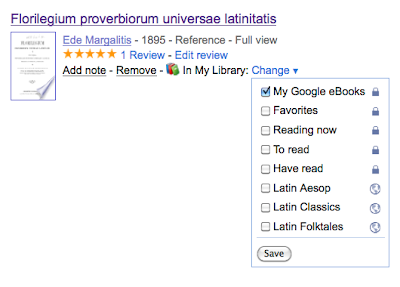
 Create Shelves. Best of all, you can now "Create a New Bookshelf" by clicking the button at the bottom of the standard library bookshelf list! These bookshelves are directly addressable by their own URL. Here, for example, is the bookshelf where I will be adding Latin Proverb books. You can have books appear in multiple bookshelves, too, as shown in this screenshot (notice also that GoogleBooks reminds you there which shelves you have flagged as public and which are private):
 I am thrilled to see that GoogleBooks has made this all so easy. I will confess that I was really hit hard when GoogleBooks abruptly discontinued the use of labels a couple of years ago, and I started using Delicious to catalog my GoogleBooks instead. But now that I can configure my own bookshelves here, save books in multiple shelves, and mark the shelves as public or private, I will start maintaining an active set of Google Bookshelves, too, in addition to using Delicious.
If anybody else out there is going to maintain some Classics or Latin or Greek Google Bookshelves, share your links here with a comment at this blog post. I'm guessing we can all learn a lot from each other this way!
.
For those of you who are not aware of how this works, each user has a Google Library which you can choose to make public, or not, based on your unique user ID. For example, you can find the public area of my Google Library here:
http://books.google.com/books?uid=11474406259561102151
(Not sure how to find that address? Just go to Books.Google.com and click on the "My Library" link which you will find in the upper right-hand corner of the screen.)
Private and Public. You will see a list of all your bookshelves to the left. To toggle between public and private, just click on the bookshelf, choose Options, then Edit Properties, and you can mark a bookshelf as public or private. Some shelves, like Review, are inherently public and some, like Recently Read, are inherently private, but for most of the shelves you can choose what to make public or private.
 Create Shelves. Best of all, you can now "Create a New Bookshelf" by clicking the button at the bottom of the standard library bookshelf list! These bookshelves are directly addressable by their own URL. Here, for example, is the bookshelf where I will be adding Latin Proverb books. You can have books appear in multiple bookshelves, too, as shown in this screenshot (notice also that GoogleBooks reminds you there which shelves you have flagged as public and which are private):
 I am thrilled to see that GoogleBooks has made this all so easy. I will confess that I was really hit hard when GoogleBooks abruptly discontinued the use of labels a couple of years ago, and I started using Delicious to catalog my GoogleBooks instead. But now that I can configure my own bookshelves here, save books in multiple shelves, and mark the shelves as public or private, I will start maintaining an active set of Google Bookshelves, too, in addition to using Delicious.
If anybody else out there is going to maintain some Classics or Latin or Greek Google Bookshelves, share your links here with a comment at this blog post. I'm guessing we can all learn a lot from each other this way!
.
Margalits: Florilegium Proverbiorum Universae Latinitatis
Florilegium Proverbiorum Universae Latinitatis: Proverbia, Proverbiales Sententiae Gnomaeque Classicae, Mediae et Infimae Latinitatis, Eduardus Margalits. 1895.
As those of you who read my Bestiaria Proverbs blog already know, I'm hard at work on a summer project: a book of animal proverbs in Latin (a BIG book of animal proverbs - I'm aiming for 2000 proverbs and should not have any trouble reaching that goal). So, this is a great excuse to explore the many different collections of Latin proverbs available at GoogleBooks and so far my hands-down favorite is this beautiful book by Eduardus Margalits, where the proverbs are arranged alphabetically by keywords, like a dictionary. If you like learning (or teaching) Latin vocabulary in context, rather than as isolated words, this book is a dream come true!
Margalits published a Supplementum to this book which is not available for viewing at GoogleBooks, although they have scanned it. I sure hope the Supplementum will eventually become available, too!
.
Oesterley: Gesta Romanorum
Gesta Romanorum, ed. H. Oesterley. 1872.
One of my very favorite medieval Latin collections of stories is the Gesta Romanorum. It exists in many editions, and not just in Latin - but the place I always start from is Oesterley's magnificent edition of the Gesta. Most importantly, in the back of Oesterley's Gesta, at page 714, you can find his notes about parallel versions of the stories in other classical and medieval sources. It is invaluable! The reason I was prompted to write about this book today was because I shared one of the stories with a Latin student over at the TextKit Latin Learning Forums! :-)
.
Why another blog...
Blogs come and go (I've usually got about a dozen active blogs at any one time), and I felt like I just had to create a new blog to keep a record of my very favorite book discoveries at GoogleBooks and other digital library initiatives. I've been relying on digital libraries in all my work over the past several years, and it would be nice to be able to share the joy of the book discoveries I've made with others.
Here's another spur which prodded me to do this: I keep running into online articles and discussion board posts by librarians who seem intent on dismissing what GoogleBooks is doing simply because it does not fit into their expectations of what a digital library should be. I often leave some kind of comment at those articles when I find them, most recently here at Inside Higher Ed (an especially snarky post to which I felt compelled to reply), along with many other similar examples at places like the Chronicle of Higher Ed, etc. So, in addition to sharing my love of GoogleBooks by leaving comments at other people's pessimistic posts, I wanted to have a place of my own to list wonderful book discoveries as they come my way, and to share those discoveries with others!
Plus, I hope this blog will prompt me to do my "virtual civic duty" and supply quick reviews of the books that I love at GoogleBooks. So, as I blog about books here, I will also have a quick review that I can put up in GoogleBooks, too. It looks like they will show up here at my Google Books Profile - pretty nifty!
.
Here's another spur which prodded me to do this: I keep running into online articles and discussion board posts by librarians who seem intent on dismissing what GoogleBooks is doing simply because it does not fit into their expectations of what a digital library should be. I often leave some kind of comment at those articles when I find them, most recently here at Inside Higher Ed (an especially snarky post to which I felt compelled to reply), along with many other similar examples at places like the Chronicle of Higher Ed, etc. So, in addition to sharing my love of GoogleBooks by leaving comments at other people's pessimistic posts, I wanted to have a place of my own to list wonderful book discoveries as they come my way, and to share those discoveries with others!
Plus, I hope this blog will prompt me to do my "virtual civic duty" and supply quick reviews of the books that I love at GoogleBooks. So, as I blog about books here, I will also have a quick review that I can put up in GoogleBooks, too. It looks like they will show up here at my Google Books Profile - pretty nifty!
.
Subscribe to:
Posts (Atom)