Sunday, January 30, 2011

Westcott: Fifty Sories from Aulus Gellius


Fifty Sories from Aulus Gellius, ed. by John Howell Westcott (1893)

As the title page explains, these stories have been "edited for reading at sight." You will find all kinds of marvelous stories in here, including the Aesopic fable of the lark and the reapers and also Androcles and the lion, along with the story of Arion and the dolphin, the infamous horse of Sejanus which brought bad luck to all its owners, a story about Alexander's famous horse Bucephalus, and many more! Each story contains notes at the bottom of the page to help with the sight reading.

The book is not illustrated, but I could not resist including Bouguereau's Arion and the dolphin:


.

Friday, January 28, 2011

Allen & Greenough: New Latin Grammar


New Latin Grammar by Joseph Henry Allen and James Bradstreet Greenough (1916)

When I took my first Latin class back in 1983, one of the books we were required to buy was Allen & Greenough's Latin grammar and my first Latin teacher would carefully write the Allen & Greenough reference number for every topic we covered. I'll confess that I found the book very intimidating back then, but very useful nowadays - all the more so since it is available for free at GoogleBooks for everyone to use!


.

Wednesday, January 26, 2011

Landsberger: Fabulae aliquot Aramaeae


Fabulae aliquot Aramaeae by Julius Landsberger (1846)
This was one of the books I used for the Mille Fabulae et Una book last summer - the Aramaic fables are presented with a Latin translation, as you can see below:


.

Monday, January 24, 2011

Davies: Fables of Babrius


The Fables of Babrius, trans. by James Davies (1860)
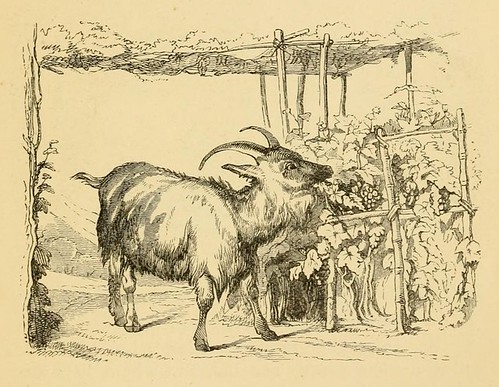
The fables of Babrius are one of the most important ancient collections of Aesopica, and these verse translations by Davies are a delight to read. Here's a sample:
A vine with foliage and ripe clusters bloom'd.
Its shoots a goat with nibbling tooth consumed,
Whom thus the vine addrest: "Why injure me?
And browse my leaves? Is there no grass for thee?
Yet thou ere long thy just deserts shalt meet.
Though now my shoots thou to the quick dost eat,
To me no less shall satisfaction rise,
When juice o'er thee I pour in sacrifice."
Hircus et Vitis

Click here for a SLIDESHOW of all the Tenniel-Wolf images.


.

Saturday, January 22, 2011

The Little Child's Fable Book (by syllables)


The Little Child's Fable Book, arranged in words of 1, 2, and 3 syllables, with illustrations by Georgina Bowers (1868)
The first section contains fables with only one syllable, followed by a section with words up to two syllables in length, and then a final section of fables with words of up to three syllables. You'd be surprised what can be done with words of a single syllable!


.

Thursday, January 20, 2011

Herford: Fifty Fables in Verse


THE HERFORD AESOP: Fifty Fables in Verse, by Oliver Herford (1921)

I've posted these delightful fables in my English Aesop blog. In addition, the book also contains illustrations by the author - here is his illustration of the frog who pretended to be a physician, fooling everyone but the fox:


.

Tuesday, January 18, 2011

Champeaux: Devises - cris de guerre, légendes, dictons


Devises: cris de guerre, légendes, dictons by Joseph de Champeaux (1890)
This is a marvelous collection of family mottos, organized by family name. Many of the mottos are in Latin, of course!


.

Sunday, January 16, 2011

Lang: Adagia, Sive Sententiae Proverbiales


Adagia, Sive Sententiae Proverbiales by Joseph Lang (1596)
This is a really excellent collection of Latin and Greek proverbs, organized by theme, with clear, concise explanations in Latin about just what the proverb means and how it is used. Highly recommended!


.

Friday, January 14, 2011

Gatty: The Book of Sun-Dials


The Book of Sun-Dials by Mrs. Alfred Gatty (1900)
This marvelous book all about sun-dials, abundantly illustrated, contains a huge appendix of sun-dial mottoes, including hundreds of sun-dial mottoes in Latin, beginning on p. 203. For digitized text, you can find a long list of Latin sundial mottoes (with Spanish translations), compiled from Gatty and other sources, at the Sundials on the Internet website. Here is a sun-dial with the motto Tempus fugit:


.

Wednesday, January 12, 2011

Bebelius: Proverbia Germanica


Heinrich Bebel's Proverbia Germanica, ed. W.H.D. Suringar (1879)
Heinrich Bebel (1472-1518) was a German humanist, famous for collecting not only proverbs but also humorous stories and anecdotes (read more at Wikipedia). Bebel's Proverbia Germanica was published in 1508 and his humorous stories, Facetiae, in 1506. Suringar's edition of the proverbs is truly masterful. He provides notes and commentary, with numerous parallel proverbs, for each of Surginar's proverbs, drawing on many otherwise hard-to-find Renaissance proverb collections. The image below shows Bebelius's court of arms as poeta laureatus:


.

Monday, January 10, 2011

Wegeler: Philosophia patrum versibus praesertim leoninis


Philosophia patrum versibus praesertim leoninis, collected by Julius Wegeler (1869).

This is an astonishing collection of nearly 1500 Latin sayings with rhyme, often in rhymed verse form (single lines or sometimes couplets). In the full title of the book you find this delightful description: iuventuti studiosae hilariter tradita. I agree that it is something hilariter tradita indeed! To get a sense of what the sayings are like, here is a widget I made with sayings taken from this book (press refresh to see different sayings displayed):


.

Saturday, January 8, 2011

Sutphen: supplement to Otto's Sprichworter der Romer


A Collection of Latin Proverbs supplementing Otto's Sprichworter und sprichwortliche Redensarter der Romer by Morris Crater Sutphen (1902)
As its title explains, this book provides proverbs supplemental to Otto's important collection of Latin sayings attested in ancient Roman authors.

.

Friday, January 7, 2011

Otto: Die Sprichwörter und sprichwörtlichen Redensarten der Römer


Die Sprichwörter und sprichwörtlichen Redensarten der Römer by A. Otto (1890)
Otto's "proverbs and proverbial sayings of the Romans" is a great reference if your main interest is in Latin sayings that are attested in Latin authors. I'm interested in the longer and broader history of Latin proverbs, but Otto provides a great core of the proverbs attested in ancient Roman sources. Be sure to check out Sutphen's supplement, too!


.

Tuesday, January 4, 2011

Pratt-Chadwick: Aesop's Fables


Aesop's Fables, by Mara Louise Pratt-Chadwick (1892)

This is a book produced for use in "first grade" of the time. I really like some of Pratt's ideas about why the fables make good reading. Here's a quote from the Introduction: "Children like to talk: they like to hear people talk. Talking is their all. Then why not let their reading book talk to them, and let them talk to it?" You can find Pratt's fables transcribed and illustrated over at my English Aesop blog.


.

Boothby: Fables and Satires


Fables and Satires by Sir Brooke Boothby (1809)
The verse fables of Sir Brooke Boothby are a wonderful contribution to the Aesop fable literature in English, and the collection is especially notable for including later Latin authors as well as fables from French, German and Italian literature. Volume 1 contains Phaedrus, Avianus, plus more Greek and Latin fables; Volume 2 contains more Greek and Latin fables, fables from La Fontaine, more European fables along with Boothby's original fables and satires in verse. I'm currently republishing Boothby's poems, with illustrations, over at my English Aesop blog.

Here is a portrait of Boothby by the painter Joseph Wright:


.

Sunday, January 2, 2011

Merivale: History of the Romans under the Empire


History of the Romans under the Empire, by Charles Merivale.
And that is the last set of items for the Roman agenda. Whoosh. It's a big agenda!

** UPDATED ** The link here to Volume 1 is to an edition that contains Chapter 11.


.

Mommsen: The Provinces, from Caesar to Diocletian


The History of Rome: The Provinces, from Caesar to Diocletian, by Theodore Mommsen, trans. W.P. Dickson.

Yet more Roman history for 2011!


.

Gibbon: History of the Decline and Fall of the Roman Empire


The History of the Decline and Fall of the Roman Empire by Edward Gibbon (7-vol. Bohn edition)
Another collection of materials for a possible Roman history adventury in 2011!


.

Mommsen: History of Rome


The History of Rome by Theodor Mommsen, trans. by W. P. Dickson
I'm seriously contemplating this notion of spending 2011 reading Roman history!

Saturday, January 1, 2011

Junius: Adagiorum


Adagiorum by Hadrianus Junius. 1558.
Although his name is not famous today, Junius (Adriaen de Jonghe, 1511-1575) provided a major contribution to the Renaissance work on proverbs with this book, considerable portions of which are repeated verbatim in Manutius's appendix to his edition of Erasmus's Adagia. There are some passages crossed out in the GoogleBooks version, so if you want to remedy that, download a copy of the book from the Munich Library here.

There is also a wonderful edition of Junius's Emblemata at the Glasgow website. It's a wonderful book, too!

Here is a portrait of Junius, found at Wikipedia:
.